
What is PAS 24?
PAS 24 stands for Publicly Available Specification 24 — a security standard developed and overseen by the British Standards Institution (BSI). It defines the minimum level of resistance a window or door must demonstrate against forced entry in order to receive certification. Put simply, it means a product has been independently tested against the methods a real opportunistic burglar would use — and passed.
The standard is currently in its PAS 24:2022+A1:2024 revision — the base version was published on 30 September 2022, superseding PAS 24:2016, and was further amended in September 2024 to keep pace with evolving criminal methods. It was developed with input from organisations including the Association of Chief Police Officers, the Glass and Glazing Federation, the Master Locksmiths Association, and the BRE.
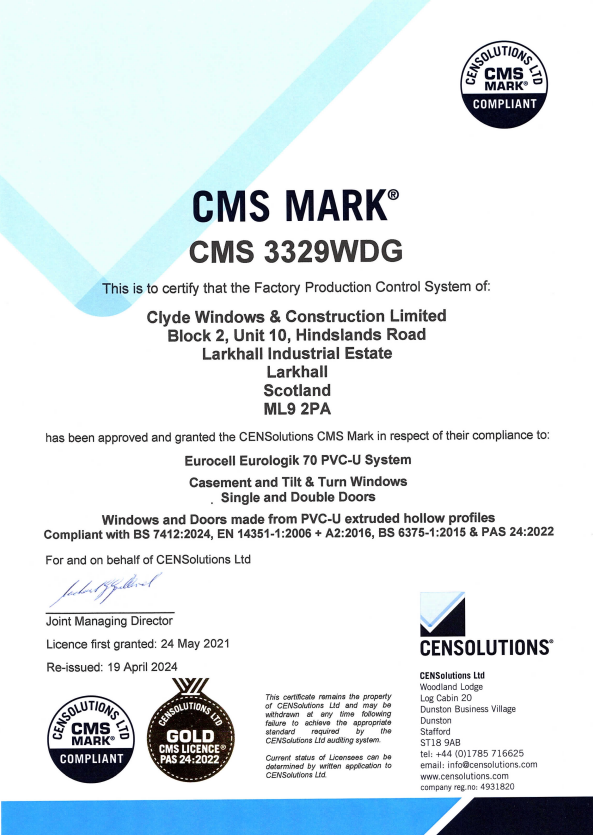
At Clyde Windows & Construction, we offer PAS 24 certified windows and doors as a security upgrade for customers who want independently verified protection. Our certification is conducted by CENSolutions and independently verified by UKAS — the United Kingdom Accreditation Service. We are also members of Secured by Design, the official UK Police initiative for designing out crime.
PAS 24 Certified vs PAS 24 Compliant — What’s the Difference?
This distinction matters and is often glossed over in the industry. A window or door can be manufactured to PAS 24 compliant specifications — meaning it is built using the correct profiles, hardware, and glass to meet the design requirements — without ever being formally tested. Only products that have physically gone through the full independent test process and received a certificate from a UKAS-accredited body can be called PAS 24 certified.
When we offer PAS 24 certified windows, that means the exact product specification has been tested and passed — not just designed to a spec on paper.
Why Choose PAS 24 Certified Windows?
PAS 24 certification is not a standard feature on every window — it is a security upgrade. Here is why it is worth considering:
- Independent verification: Certification is issued by a UKAS-accredited test laboratory — not a manufacturer’s self-assessment. If a product carries the PAS 24 mark, it has physically passed every test.
- Building regulation compliance for new builds: Approved Document Q (England) makes PAS 24:2022+A1:2024 — or an equivalent standard — a legal requirement for accessible windows and doors in new build homes. This obligation is specific to new builds; if you are replacing existing windows or having an extension built, Part Q does not currently apply, though choosing certified products remains a worthwhile investment regardless.
- Potential insurance benefits: Some home insurers offer reduced premiums where PAS 24 certified products are fitted — the certification is recognised as a meaningful indicator of reduced forced entry risk, which can work in your favour at renewal.
- Long-term durability: The testing process covers not just security but functionality and weather resistance — so certified products are built to last, not just to pass a single test.
How PAS 24 Certification is Obtained
To obtain PAS 24 certification, a manufacturer must submit their products to an independent UKAS-accredited test laboratory. The testing covers four main areas — security attack, mechanical force, functionality and durability, and weather resistance. Every test must be passed; there is no partial certification or grading system.
Manual Attack Tests
An engineer is given 15 minutes to attempt to breach the window or door using a standard toolkit of tools that could realistically be concealed and carried to a property — screwdrivers, chisels, crowbars, and similar implements. This replicates the real-world methods used by opportunistic burglars more closely than any machine test can.
- Manipulation tests: The engineer attempts to disengage or bypass locking mechanisms and hinges without causing visible damage — using scrapers, cards, or probing tools.
- Glazing removal tests: The engineer tries to remove the glazing bead and glass panel from the frame — a common real-world attack method often overlooked by homeowners.
- Cutting tests: The product fails if the engineer can cut a hole greater than 50mm in diameter. For doors, two zones are tested: within 400mm vertically either side of the lock, and everywhere else — each lasting 3 minutes.
- Cylinder and hardware attack (doors): Lock cylinders, handles, and hardware are attacked with tools simulating lock-snapping, drilling, pulling, and mole-gripping.
Mechanical Attack Tests
Calibrated machines apply forces well beyond what a human attacker could generate, testing the structural integrity of the frame, profile, and locking points.
- Glazing frame test (windows): 200kg of force is applied to each corner of the window over a 20-second period. The corners are where the frame is structurally most exposed, so this test targets the area most likely to give way under real attack.
- Mechanical loading (windows): 300kg of force is applied perpendicular to each piece of hardware, replicating the prying action of a crowbar. The frame is then tested again with a further 100kg press to check it hasn’t been weakened.
- Mechanical loading (doors): The same test applies a higher force of 450kg to multiple points across the door.
- Soft body impact: A 30kg sand-filled leather bag is dropped from 800mm in a pendulum motion three times, simulating a shoulder-barge or kick across a wide area of the door or window.
- Hard body impact: A 50kg metal battering ram is released from 800mm in a pendulum motion three times, applying concentrated force to a specific point on the frame or panel.
Functionality and Durability Tests
A product that passes attack tests but fails after a few years of use provides no lasting value. These tests confirm reliable performance over time.
- Cyclic testing: The window or door is put through thousands of open-and-close cycles to confirm locks, hinges, and handles remain fully functional with repeated use.
- Operational force: The force required to open and close the product is measured to ensure security features do not compromise day-to-day usability.
- Load bearing: A downward force is applied to test whether the window or door sags or binds — both of which can compromise security and function over time.
Weather Resistance Tests
PAS 24 also requires weather performance testing to the BS 6375 standard series, confirming the product remains durable against wind and rain — a practical requirement in Scotland’s climate.
- The window or door is placed in a pressure chamber where varying air pressure levels simulate wind loading against the frame.
- Water is simultaneously sprayed onto the exterior to test for any ingress or leaks under pressure.
The Certification Outcome and Ongoing Compliance
PAS 24 is a strict pass-or-fail standard — there is no grading system. Only products that pass every test receive the certificate. Importantly, certification does not end there: the UKAS-accredited body carries out regular factory audits and re-testing to ensure ongoing compliance. If any component of a certified product changes, the product may need to be re-submitted for testing entirely.
PAS 24 and Secured by Design — Are They the Same?
No — and this is a common point of confusion. PAS 24 and Secured by Design (SBD) are independent of each other, but they are linked: PAS 24 certification is a prerequisite for Secured by Design accreditation. A product must first pass PAS 24 before it can even be considered for SBD, which then applies further Police-recommended security and design requirements on top.
SBD is operated on behalf of the UK Police. Its focus extends beyond just the product — it looks at the broader security of homes and their environments. We hold a Secured by Design licence, which means our certified products meet both standards.
Our Certifications and Accreditations
Below is a full list of the independent certifications and accreditations held by Clyde Windows & Construction — all issued or accredited by UKAS-recognised bodies.
CMS 3329WDG — PVC-U Window & Door Stability
Certified products: Casement and Tilt & Turn Windows, Single and Double Doors
- BS 7412:2024
- EN 14351-1:2026 + A2:2016
- BS 7375-1:2015
- PAS 24:2022
CMS 3329WDB — Factory Production Control
Certified products: Casement and Tilt & Turn Windows, Single and Double Doors
- BS 7412:2024 & BD EN 14351-1:2006
- EN 14351-1:2026 + A2:2016
- Factory Production Control
CMS 3329WDS — Weather Performance
- BS 7412:2024
- BS EN 14351-1:2006 + A2:2016 / BS 6375-1:2015
Secured by Design — Licence Holder
QCC Mark — PAS 24 Product Certification
Certificate Number: QCC 90277
Scope: Manufacture of PVC-U Windows & Doors