

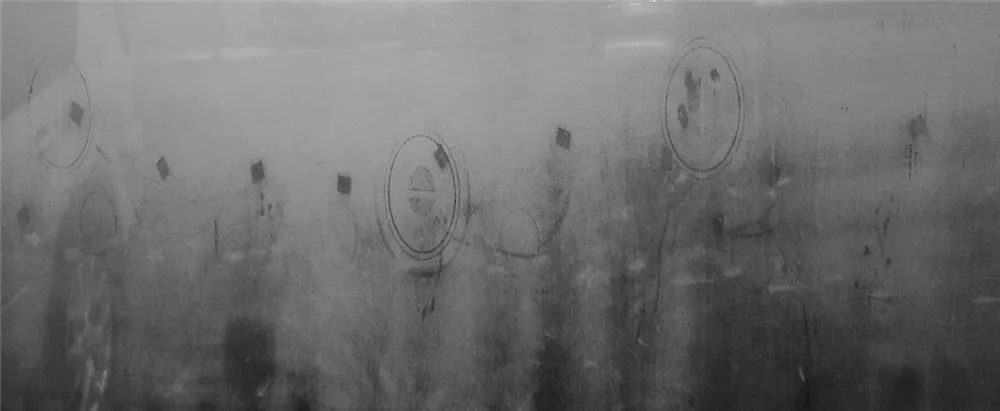
Overview: Suction cup marks on windows
Suction cup and pad marks on new windows are a normal by-product of the manufacturing and installation process. They become visible mainly when condensation forms but do not represent a fault in the glass.
Understanding this interaction between moisture and surface characteristics can help reassure property owners that their windows are functioning as intended.
When new windows are installed, some customers notice faint circular or rectangular marks on the glass—particularly when condensation forms on the outside. While these marks can be concerning at first glance, they are generally harmless and related to standard manufacturing and handling processes.

Types of marking on windows
The marks that appear on new windows typically fall into two categories:
- Suction cup marks: Circular impressions left by suction equipment used to lift and position glass during manufacturing or installation.
- Pad marks: Smaller rectangular shapes caused by protective spacers placed between panes during storage and transportation to prevent scratches.
These marks are not scratches or damage. Instead, they are subtle surface variations that become visible under certain conditions.
Why Do These Marks Appear?
Glass may look perfectly smooth, but at a microscopic level it has tiny peaks and valleys. During handling, minute particles from suction cups or protective pads can settle into these surface features. While invisible under normal dry conditions, they can slightly change how moisture behaves on the glass.
When condensation forms, water droplets gather differently on these areas, making the marks temporarily visible.
Whether or not a window develops exterior condensation is actually a rather complex bit of environmental and performance issues. For example, condensation is much less likely to form on a cloudy night. Trees or other obstructions close to the windows, bushes under the windows, and even the length and angle of the soffit or other overhangs can affect the formation of condensation. A tiny change in either
temperature or humidity from one room to the next might raise or lower the dew point just a little bit and you might see a whole different level of condensation.
Condensation occurs when the glass surface temperature drops below the dew point—the temperature at which air becomes fully saturated with moisture.
On modern energy-efficient windows, exterior condensation is quite common. Because these windows are designed to reduce heat transfer, the outer pane can remain cool enough for moisture in the air to condense on it.
This is actually a sign that the window is performing effectively. Exterior condensation:
- Is normal and expected in certain conditions
- Does not indicate a defect
- Does not affect the lifespan or performance of the unit
Environmental factors such as clear night skies, nearby vegetation, building overhangs, and slight changes in humidity can all influence when and where condensation appears.
Will the Marks Go Away?
In most cases, suction cup and pad marks will gradually fade over time as the glass is exposed to normal weather conditions.
If needed, they can sometimes be reduced by careful cleaning or light polishing using a suitable glass polishing compound (such as a cerium oxide-based cleaner). However:
- Always follow manufacturer guidance
- Avoid abrasive cleaning methods
- Do not polish self-cleaning glass unless specifically advised
Do the Marks Indicate a Problem?
No—these marks are cosmetic and do not affect the structural integrity, insulation performance, or durability of the window.
Replacing the insulated glass unit (IGU) is unlikely to produce a different result, as similar handling processes are used across manufacturing.